
Music theory in the shape of the instrument
Guitar theory often arrives as two separate subjects: abstract names on one side and memorised shapes on the other. Players can know a scale pattern without seeing its intervals, or recognise a chord diagram without understanding how that voicing relates to the rest of the neck.
GuitarWeaver puts the relationship back in view. Its tools share the same musical context, so a scale can lead to its notes, a chord can reveal its construction, and a progression can move from an idea into something playable. The goal is not to replace the instrument. It is to make the next minute with the instrument more informed.
- ExploreIdentify notes and chord shapes directly on an interactive fretboard.
- VisualiseSee scales, intervals, and chord tones across the neck.
- WriteBuild chord progressions and keep musical context close.
- PractiseUse tabs, a metronome, and focused skill challenges.
A fretboard explorer for questions that start with a shape
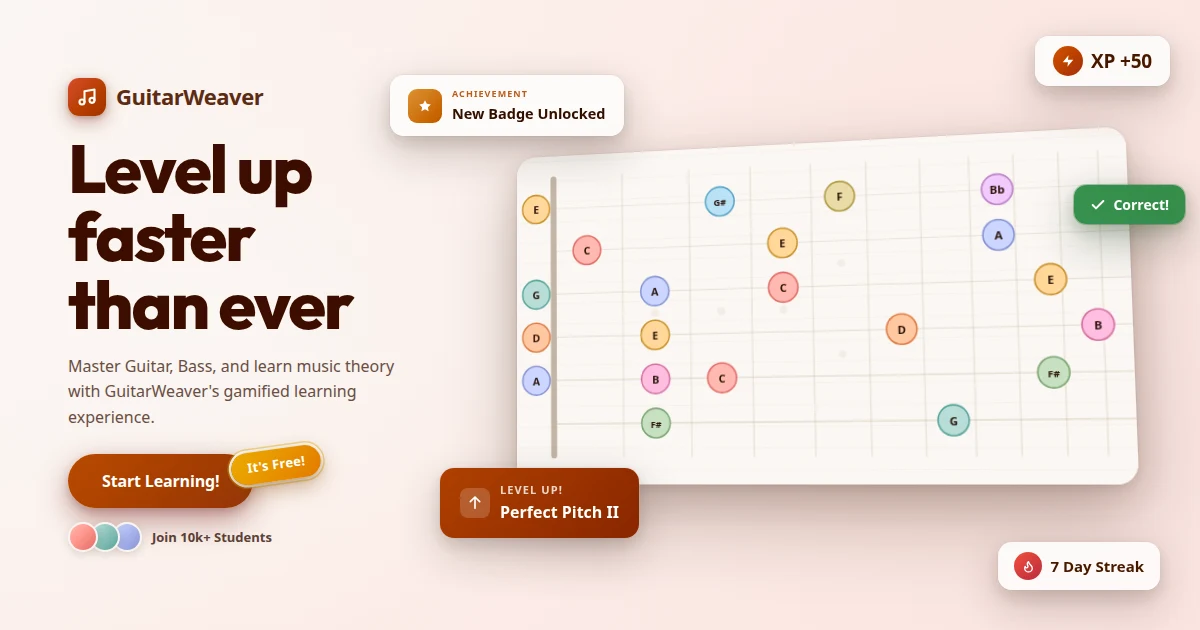
Sometimes you know where your fingers are but not what you have made. The Fretboard Explorer lets you select frets and identify the resulting chord. The reverse is useful too: start from a musical idea and inspect where its notes appear across the instrument.
That back-and-forth matters because fretboard fluency is not one act of memorisation. It is the ability to connect a location, a note name, an interval, a sound, and a harmonic job quickly enough that the knowledge survives contact with playing.
Scales and chords as related material
The Scale Lab shows patterns across the neck in any key, helping players move beyond a single box shape. The Chord Builder exposes voicings and inversions so a chord becomes a set of musical choices rather than one fixed diagram.
Used together, these views answer practical questions: Which chord tones are already under this scale shape? Where is the nearest third? What changes when a voicing is inverted? Theory becomes easier to retain when each answer is visible and immediately playable.
Study tabs with the theory still attached
Guitar tablature is direct: it tells you where to play. The Tab Player keeps that practical strength while making room to study what the music is doing. Playing a part, examining the underlying progression, and returning to the fretboard turns a copied shape into reusable understanding.
Build progressions with intent
The Progression Builder is a place to assemble and save harmonic ideas. Instead of treating chord progressions as disconnected formulas, GuitarWeaver keeps them near the chord and scale tools that explain why a movement works and where it can go next.
This is useful for songwriting and for practice. A progression gives scales, arpeggios, timing work, and ear training a musical frame. The same four bars can become a lesson in chord tones, voice leading, rhythm, or improvisation.
Practice that produces recognition
GuitarWeaver includes a metronome and skill challenges for areas such as pitch, chord recognition, and fretboard fluency. Progress and achievements add continuity, but the underlying aim is recognition: seeing or hearing something and knowing what it is without rebuilding the answer from zero.
The guide to learning the guitar fretboard visually sets out a practical sequence for using these tools without turning practice into screen time.